
|
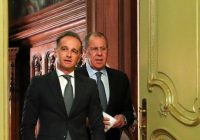
 German Defense Minister Thomas de Maizière on Afghanistan: “The timetable agreed in Lisbon still applies. And that means the mission ends at the end of 2014, conditions-based, and no earlier.”
Europe will remain Washington’s “partner of first resort,” but much else has changed – By Theo Sommer
Sixty years ago, the Munich Security Conference first brought
together defense experts from all over the world to discuss questions of
war and peace, confrontation and accommodation, tension and détente.
This year’s meeting, once again held in the Bavarian capital over the
first weekend of February, was unusual in several regards.
For the first time in six decades, the US administration was
represented by two cabinet members, Secretary of Defense Leon Panetta
and Secretary of State Hillary Clinton. Obviously they thought that it
took two to placate the Europeans, many of them deeply disturbed by the
defense guidelines recently proclaimed by President Obama. The new
doctrine signaled a “strategic shift” (Clinton), a “broader shift” of
American foreign policy (Obama) to the Asia-Pacific and the Middle East.
The way it was presented seemed to suggest that the United States,
focusing on rising China and nuclearizing Iran, is about to “pivot” and
turn its back on Europe.
|
|
Read more...
|
|
|
 On the podium in Munich: former Secretary of State Henry Kissinger, China’s Vice Minister of Foreign Affairs Zhang Zhijun, Senator John McCain, Singapore’s Minister of Defense Ng Eng Hen, Australia’s Foreign Minister Kevin Rudd and EU Commissioner Michel Barnier (from left).
“You’ve probably seen it around the conference,” US Senator John McCain said , as he began his remarks at the 48th Munich Security Conference by holding up a copy of The Security Times, a special edition of The Atlantic Times published exclusively for the annual defense gathering. (video)
“It shows a forceful bat-wielding Yankee dueling with a crouched yet fearsome Chinese swordsman. That obviously suggests a looming Cold War in Asia.” It’s a nice caricature, the senator said as he went on to describe “what is really going on in my view.”
On recent trips to the Philippines, Vietnam, Thailand and Burma, McCain said he experienced “real enthusiasm for our growing involvement in the region.” On China: “The peaceful development of China is in the interest of the US.”
|
|
|
 Anti-Bashar writings on the wall in Damascus: Russia is drawing its own conclusions about the Syrian uprising.
Can Germany convince Russia to switch sides on Syria? – By Jochen Bittner
This may hurt. But it’s necessary. To understand Russia, let’s look
at Syria and the Arab Spring from Moscow’s clear and cynical viewpoint.
First of all, it makes no difference to the Kremlin whether a hundred
or thousands of people die in Homs or Damascus. That’s because there is
no Russian civil society to whom that might matter.
Second, If Syrian President Bashar al-Assad falls, his allies in Iran
could be next. That would be an economic catastrophe for the Kremlin,
because the anti-Western dictatorial co-op “Syran” is a big market for
Russia’s important arms and nuclear industries.
|
|
Read more...
|
|
|
 Dmitry Medvedev, Nicolas Sarkozy and Barack Obama at the NATO-Russia Council summit in November 2010. Relations between Moscow and the alliance have since hit a plateau, with no major agreement in the last 15 months.
How to improve relations between NATO and Russia – By Dmitri Trenin
After the vigorous surge that led to the Lisbon NATO-Russia Council
summit in November 2010, relations between Moscow and the alliance have
hit a plateau. In the last 15 months, no major agreement has been
reached, or is about to be reached. True, there has been no crisis
either. However, unless the relationship moves forward, it will stagnate
and risk backsliding.
The core issue in the relationship is the deficit of trust. Russians
do not trust US long-term intentions; Russia’s neighbors from Central
and Eastern Europe do not trust Russia’s. In 2010, this was well
understood. NATO offered Russia cooperation on missile defense (MD), and
Russia moved to address Stalin’s crimes at Katyn.
|
|
Read more...
|
|
|
 Italian fighter pilots show off their stuff. EU countries are safer than they have been for decades so defense cuts in a time of financial crisis should not be ruled out.
The EU needs a joint Defense Review initiative – By Mark Leonard
At last year’s Munich Security Conference, NATO Secretary General
Anders Fogh Rasmussen took to the stage to lecture European leaders
about cuts: “Over the past two years, defense spending by NATO’s
European member nations has shrunk by some 45 billion dollars – that is
the equivalent of Germany’s entire annual defense budget,” he
complained. He then went on to say that China had tripled its defense
expenditure over the past decade, while India increased spending by
almost 60 percent.
The NATO boss’s speech was echoed a few months later by outgoing US
Defense Secretary Robert Gates in his valedictory speech in Brussels,
when he warned of Congressional unwillingness to continue to pay for the
defense of “nations apparently willing and eager for American taxpayers
to assume the growing security burden left by reductions in European
defense budgets.”
|
|
Read more...
|
|
|
Only their dictates can force the Europeans to streamline defense efforts – By Christoph Bertram
As the sovereign debt crisis hits European defense budgets, the obvious
response would be a pooling of European military assets and resources.
But it is not happening. Defense Ministers and their bureaucracies still
seem to have enough funds available to avoid that choice. Only if
finance ministers threaten to impose even deeper cuts on defense, will
European defense integration get a chance.
|
|
Read more...
|
|
|
 “Side by side, we are fighting for peace in Afghanistan.” Bundeswehr troops on a mine-clearing mission near Kunduz.
“Germany will make its contribution to a peaceful world” – By Thomas de Maizière
At the beginning of 2012, the international community is facing many
challenges. The financial crisis, the public debt crisis and the
development of the economy are determining the political agenda in
capitals on both sides of the Atlantic.
Despite the absolute need to concentrate on resolving these crises,
we will not be granted a reprieve by the global security situation. The
course of developments in the Arab world, which remains unpredictable,
Iran’s almost unchecked progress on the way to becoming a nuclear power
and the increasing challenges in cyberspace are examples of the complex
and dynamic security environment of today and tomorrow. Ensuring
security in a responsible way today necessitates the ability to react
simultaneously and concurrently to multiple challenges.
|
|
Read more...
|
|
|
 At the Pentagon, Jan. 3, President Barack Obama presented Washington’s new strategic doctrine. It signifies a “broad shift” of American foreign policy.
China and the United States compete for supremacy in the Pacific – By W. R. Smyser
On Jan. 3, President Barack Obama announced a new US strategic
doctrine with potentially major impact on American alliances in Asia and
Europe. The doctrine shows a clear intent to maintain America’s
preeminent military position in the world as well as its full range of
global interests and commitments.
But the doctrine shifts both the level of US military effort and its
areas of concentration. It will reduce US planned defense expenditures
by $488 billion over a period of ten years, although the defense budget
will still grow slightly over that time. The doctrine will also
concentrate American strategic assets more in Asia.
|
|
Read more...
|
|
|
 No one misses a photo opportunity. But when action is required, many go AWOL.
The continent should actively rejoin the Atlantic security community – By John Kornblum
President Obama’s new defense strategy hit Europe with full force.
The new emphasis on Asia, withdrawal of two combat brigades from Europe
and reduction of war fighting capability was seen by many as the final
departure from direct engagement in Europe.
The American decision reflected a disturbing paradox which has
defined transatlantic security relationships since the late 1990s: The
more Europe has sought to define a separate security identity, the less
the United States has considered a transatlantic security community to
be useful in pursuit of its interests.
|
|
Read more...
|
|
|
As the United States pivot to Asia it will need Europe more than ever – By Anne-Marie Slaughter
Amidst America’s much-vaunted “pivot to Asia” and the Eurozone’s
ongoing financial crisis, it is rather unfashionable to stand up for
Europe. Still, for those who believe in actual facts rather than dreams
and projections, it bears pointing out once again that the EU is the
world’s largest economy.
The IMF and the CIA World Factbook both list the EU as the largest
economy, $2 trillion ahead of the US and $10 trillion ahead of China;
the World Bank’s figures put the US ahead, but still grant the EU a very
respectable $12 trillion GDP for 2010.
|
|
Read more...
|
|
|
While China and the US vie for hegemony, an arms race is underway in the region – By Ulrich Weisser
A strategic tug of war has begun in the Western Pacific. The question
of regional hegemony, and therefore also the question of who will
dominate the 21st century, will be decided between China and the US. The
world’s two largest economies square off against each other with
undisguised rivalry. But other nations in the region are also involved
in this geopolitical tussle.
India’s biggest security headache is that it cannot interpret China’s
intentions and does not know how far Beijing’s expansion strategy will
reach. The ambitious, strategically driven naval construction program
makes the Indian government nervous. India feels encircled. The
overlapping political, economic and strategic interests of India and
China in the Indian Ocean are defined by competition, but increasingly
also by strategic maritime rivalry.
|
|
Read more...
|
|
|
 Chinese police pose with a People’s Liberation Army flag.
Instead of being alarmed, the West should focus on co-evolution – By Eberhard Sandschneider
Debating the rise of China has become one of the most controversial
issues of our time. The prevailing skepticism of many Western
assessments appears to neglect the argument that China’s rise is, after
all, a normal and legitimate process, whether we like its effects or
not.
The rise and fall of nations is an integral characteristic of
perpetual change in international relations. The 20th century witnessed
the rise of the US as well as the USSR’s ups and final down in 1991. It
experienced Germany’s historical disasters and its astonishing economic
and political resurrection after 1949, as well as the continuous decline
of two former global powers: Britain, where the loss of former glory
was endured with a stiff upper lip, and France, without the French elite
seemingly even noticing.
|
|
Read more...
|
|
|
 One hundred governments, meeting on the Petersberg near Bonn, agreed on a strategy to pacify and stabilize Afghanistan beyond 2014, when foreign forces will be withdrawn.
Our political strategy for Afghanistan stands, but the road ahead will still be tough – By Michael Steiner
In recent weeks, three elements have solidified the strategic consensus on Afghanistan.
First element: On Dec. 5 last year in Bonn, one hundred participating
governments and international organizations made a firm commitment to
support Afghanistan beyond ISAF (International Security Assistance
Force) through a “Transformation Decade” from 2015 to 2024. All
participants recognized that a political solution is indispensable and
committed to seven crucial principles.
|
|
Read more...
|
|
|
 “Taliban insistence that they will only talk with the Americans is not realistic in the long term.” A former Taliban fighter joining the Afghan army at a recruitment ceremony in Kandahar on December 20, 2011.
Direct negotiations with the radical Islamists are key to lasting Afghan and regional stability – By Ahmed Rashid
After eleven years of war the Taliban’s public declaration that they
will hold talks with the United States in Qatar is a major breakthrough
for the political process, for Afghanistan’s internal stability and for
the relative peace that will be needed by the US and NATO in 2014 before
they can exit Afghanistan in good order and without too much bloodshed.
The year-long clandestine talks brokered by the Germans, fostered by
Qatar and eventually ending in direct meetings between US officials and
Taliban representatives will hopefully lead to a major reconciliation
with the Kabul regime. The Taliban’s present insistence that they will
only talk with the Americans is not realistic in the long term, while
Karzai’s recent policy flip-flops and contradictory statements belie the
fact that he was kept in the loop every step of the way by the Germans.
The talks will go ahead because there is no other alternative to ending
the war.
|
|
Read more...
|
|
|
The Arab world must decide how it wants to move forward – By Volker Perthes
Since the fall of Tunisia’s Ben Ali and Egypt’s Mubarak one year ago,
it has become evident that the political transformation of the Arab
world is a complex, often violent, and protracted process that has only
just begun. Many observers like to speak of an “Arab Spring.” This
concept is much too seasonal, breeding impatience and disappointment
rather than making us think about our – Europe’s and America’s –
long-term strategic engagement with the region.
The Arab world still finds itself within the first five minutes of
its current historical hour. Four factors seem particularly important to
watch, and to take into account, as the Arab revolts enter their second
year.
|
|
Read more...
|
|
|
 The rate of attacks in Iraq has increased since December last year. This car bombing in Sadr City in Baghdad on Jan. 24, 2012 was one of a series in Shiite areas of the capital.
Iraq could become the battlefield in a proxy war between Iran and Saudi Arabia – By Guido Steinberg
The latest news from Iraq recalls the worst periods of the 2005-2007
civil war that brought the country between the Euphrates and the Tigris
to the brink of total collapse. Almost 70 people were killed in attacks
on civilians in Baghdad and Nasiriya in early January, and more than 100
were wounded, many seriously.
Hardly a day passes without suicide bombers killing dozens of people.
As before the civil war, Sunni terrorists are again trying to provoke
the Shiites into retaliation as a way of destabilizing the country as a
whole.
|
|
Read more...
|
|
|
 First think, then act. The hasty imposition of sanctions against Iran could provoke a military escalation. The photo shows a wall painting in Tehran.
Drastic economic actions against Iran make military confrontation more likely – By Vali Nasr
The United States and its European allies have reacted to the recent
IAEA report on Iran’s nuclear activities with new and tougher sanctions,
but have ruled out military strikes for the time being. They ought to
be the last option, US Defense Secretary Leon Panetta said in a recent
speech, because there is still time for economic pressure and diplomatic
isolation to persuade Iran. But that looks increasingly unlikely. The
crippling sanctions that the US and its European allies are about to
implement, combined with ending purchases of Iranian oil and encouraging
other OPEC countries to up their production quotas, would drastically
cut Iran’s revenue.
|
|
Read more...
|
|
|
 Cause for concern: “Iran has stepped up production of 20 percent enriched uranium, which is close to weapons grade.” A satellite image of Iran‘s suspected nuclear bunker at Fordo.
A pre-emptive attack on Iran’s nuclear program would be an act of folly – By Mark Fitzpatrick
Ominous developments of late over the Iranian crisis suggest that two
worst-case outcomes are both becoming more likely. Iran continues to
inch closer to becoming nuclear-armed and the prospect of pre-emptive
war may have become more real.
Despite all the means that have been employed against it – sanctions,
financial pressure, cyber attacks, sabotage and assassinations – as
well as all the incentives that remain on the table, Iran continues to
produce low-enriched uranium for which it has no civilian need. If
further enriched to weapons grade, Iran’s stockpile is sufficient for up
to four implosion bombs.
|
|
Read more...
|
|
|
States cannot control the digital realm – By Myriam Dunn Cavelty and Oliver Rolofs
Cyber war is a terrible metaphor. Even Barack Obama’s cyber security
czar Howard Schmidt has admitted as much. But experts and state
officials use it persistently and military terminology has infiltrated
the cyber security debate.
Analogies are a useful way of explaining non-familiar concepts or
complex ideas in terms of simpler and more commonplace ones. But if
taken too far, the disadvantages start to outweigh the advantages.
|
|
Read more...
|
|
|